

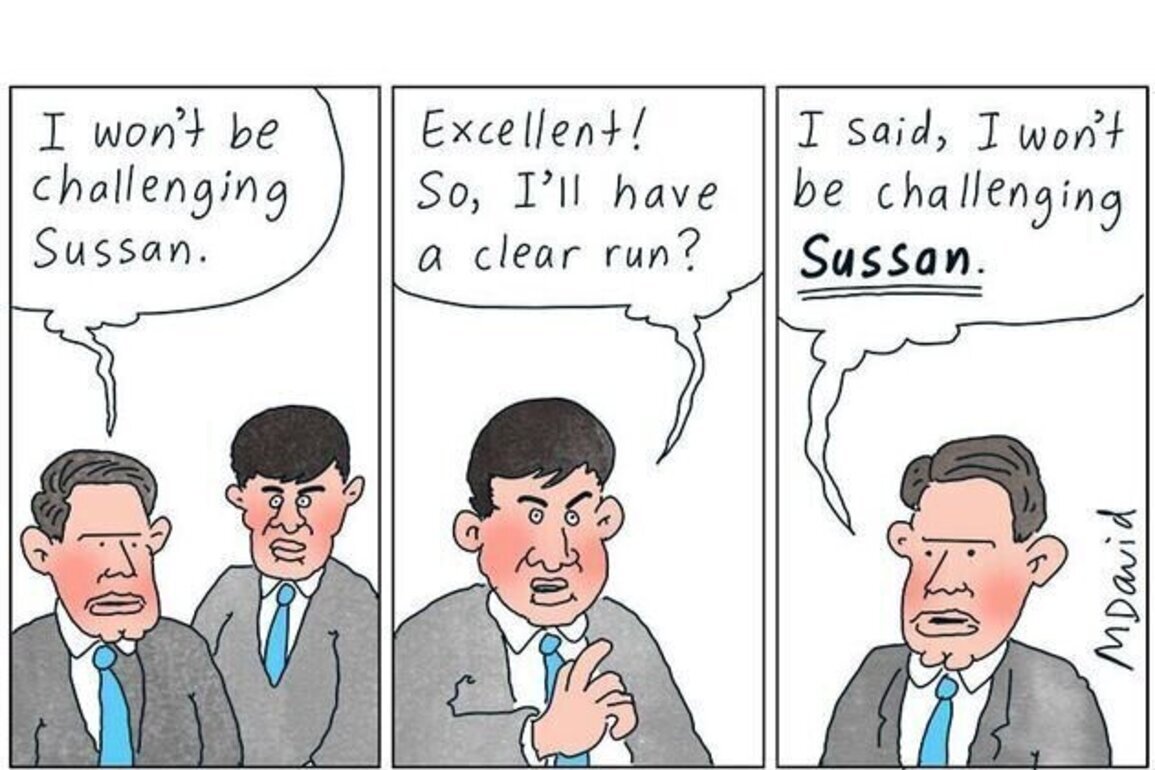
With Liberal leadership aspirant Andrew Hastie expressingopenly challenging "neoliberalism",which has anchored Coalition politics for decades, the political protection business once enjoyed can no longer be taken for granted, writesProfessor Carl Rhodes.
OPPOSITION LEADER Angus Taylor seemed guarded. Appearing onSky Newslast week, he was repeatedly pressed by hostAndrew Clennellabout his relationship with Liberal colleague and possible leadership rival, Opposition industryspokesperson Andrew Hastie.
Is he [Hastie] after your job? Clennell asked. Taylor laughed, then pivoted to tax, housing,and oil and gas.
Clennell did not let go. But is he after your job? he repeated. Taylor laughed again. Eventually, he responded without really answering. Andrew and I are good friends and have been for a long while.
The question lingered because, only weeks earlier, Hastie had openly challenged "neoliberalism",the worldview that has anchored Coalition politics and its relationship with business for decades.
The consequences of that challenge remain unclear, but the business sector is on notice that the political protection it once enjoyed can no longer be taken for granted.
Hastie breaks rank
Things had been brewing since Andrew Hastie spoke onABC Insiderson Sunday 29 March.
Asked about his support for windfall taxes on gas exports, Hastie said:
He went further, adding:
The next day, Taylor shut him down stating unequivocally that increasing taxes was opposed to the long-standing understanding of the economics profession in the Liberal Party.
Neoliberalism is rarely named by conservative politicians, let alone something they bicker about in public. It is, however, the doctrine the Coalition and the Liberal Party in particular has long championed.
It was embraced enthusiastically under John Howards government from the late 1990s, through market liberalisation, industrial relations reform, privatisation of state enterprises, financial deregulationand significant reductions in corporate taxation.
Neoliberalism is also the word traditionally used by the Left to criticise this policy agenda, particularly the inequality it fuelled by shifting power, income, and security away from labour and towards capital.
On the face of it, Hasties language overlaps with elements of that critique, for example when he says that a lot of Australians feel like the system is rigged against them and that were experiencing a lot of economic pain as the global order fractures.
The Liberals old deal is cracking
Hasties point is not a progressive one. It is a pragmatic acknowledgement that the Right will be punished if it is seen as defending a system more and more people experience as unfair.
His clash with party orthodoxy is not a left turn. It does, however, signal a shift in the issues now cutting across the political spectrum. Economic malaise is spreading as housing is unaffordable for many, costofliving pressures are intensifyingand younger Australians increasingly believe they will be worse off than their parents.
The neoliberal order has lost credibility, even among those who once backed it without reservation. It may previously have seemed selfevident that investment, growth and shareholder value would flow through to all Australians. That faith has been eroded by inequality, wage stagnationand repeated episodes of corporate misconduct.
That the Liberal Party is now debating neoliberalism, however clumsily, is a sign that something fundamental has shifted. The economic settlement that once aligned markets, business, and political legitimacy no longer commands automatic consent.
If that settlement changes, it will shape not only the partys future but the conditions under which business is judged to serve the public good. That assessment is unfolding in real time.
Business is on notice
Behind this moment in the news cycle lies a deeper shift in public expectations of business itself. Corporations are no longer assessed solely on their ability to generate growth, investment, or shareholder returns.
When inequality is at levels not seen for decades and when conservative politicians begin withdrawing automatic support for business, it is a sign of just how far the system has frayed. Business is increasingly judged by whether it contributes to economic fairness, through responsible practices, paying taxand providing secure wellpaid work.
Scrutiny can be expected on everything from superprofits and resource rent to wage theft, insecure work, market power and pricesettingand the political influence that comes with concentrated wealth.
That figures on the conservative side of politics are now framing issues in these terms highlights the depth of the problem.
For business leaders, the implications are stark. They must reckon with the political and social consequences of an economic model that has delivered prosperity for some while leaving many others excluded, insecure,and unheard. Failure to adapt risks leaving corporate leaders politically isolated, defended by a shrinking circle of allies, but stripped of broader legitimacy.
The challenge for corporate Australia is no longer how to protect markets from politics, but how to act credibly in the national interest, recognising that economic power carries civic responsibilityand that longterm legitimacy depends on more than growth alone.
If business cannot be credibly seen to be contributing to the public good, it will not just face pressure from the Left. It will face it from everywhere.
Carl Rhodesis Professor of Business and Society at the University of Technology, Sydney. He has written severalbookson the relationship between liberal democracy and contemporary capitalism. You can follow him on X/Twitter@ProfCarlRhodes.
Related Articles
- Australian CEO pay scandal averted by PR spin and media churnalism
- Australia's economic future: The neoliberal lie
- Putting an end to neoliberalism
- The corporate criminals killing off democracy
- Democracy: An unachievable work in progress